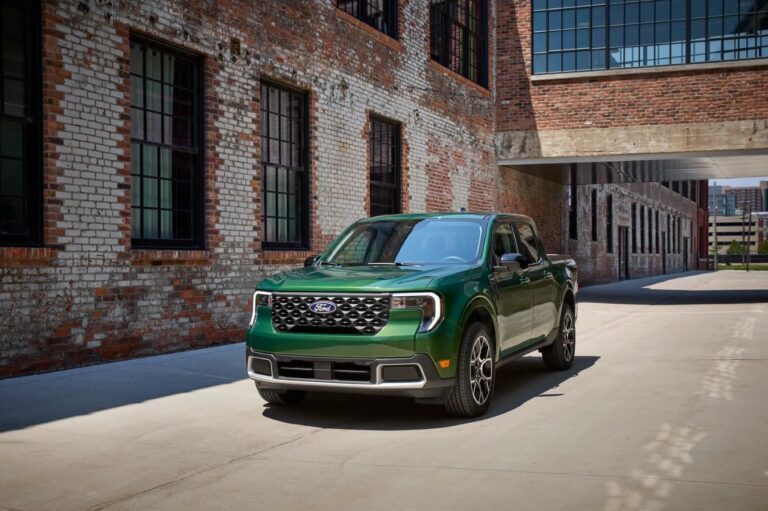
2028 Ford Maverick Lobo Redesign, Price, Specs
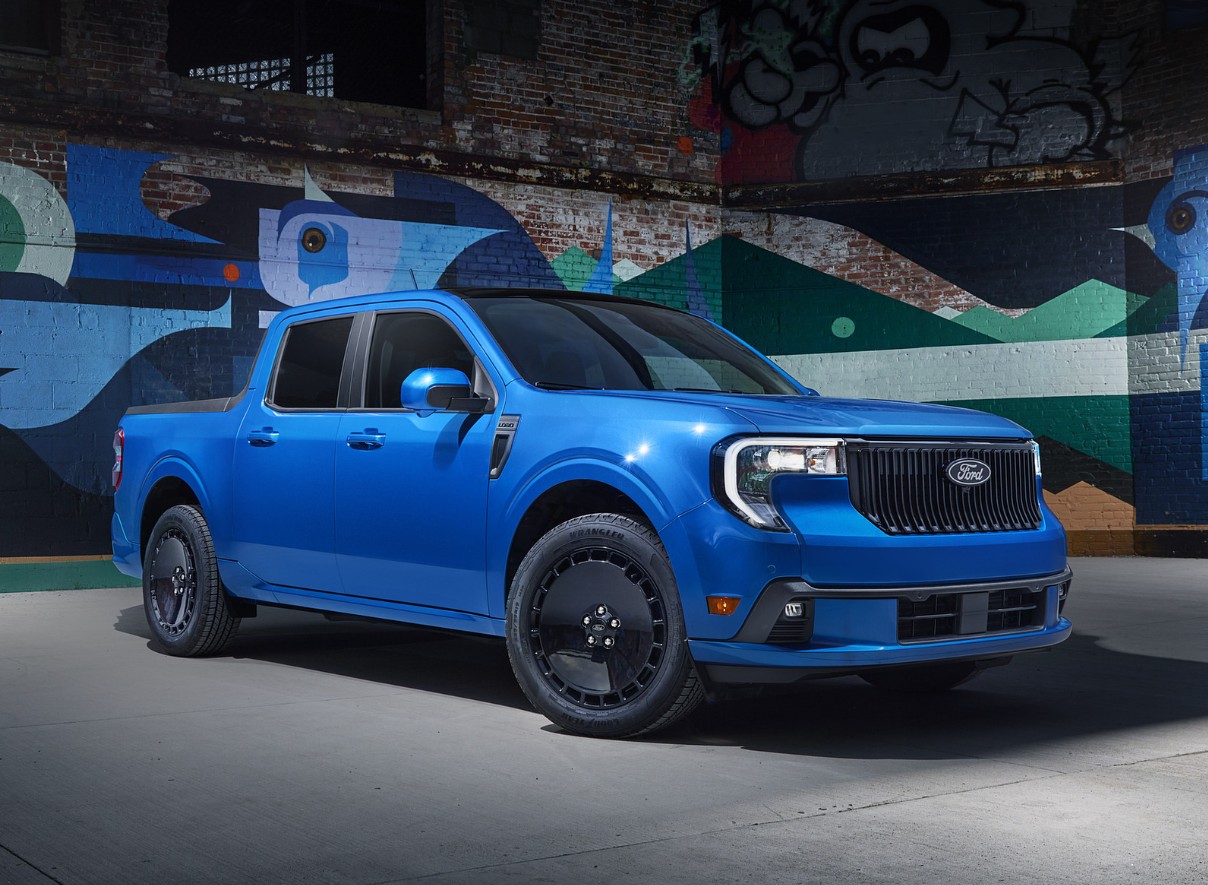
The 2028 Ford Maverick Lobo could become one of the most distinctive compact performance trucks in Ford’s lineup if the company continues developing the street-focused formula introduced with the current Lobo. Ford has not officially announced a 2028 Maverick Lobo, so its future specifications, pricing, trim structure and release date remain unconfirmed. The existing 2026 Maverick Lobo provides a strong indication of what a future model could build upon. It combines a 2.0-liter EcoBoost engine, advanced 4WD with a twin-clutch rear drive unit, a seven-speed quick-shift transmission, performance-tuned suspension and steering, enhanced brakes, paddle shifters and an exclusive Lobo drive mode. Ford lists the current model at 250 horsepower, making it substantially different from the efficiency-oriented Maverick Hybrid.
The Lobo’s appeal comes from its unusual mission. Most compact pickups are designed around utility, fuel economy or off-road capability, whereas the Maverick Lobo is deliberately tuned for paved roads and aggressive cornering. Ford developed it partly in response to a long-standing street-truck culture in which owners lowered pickups, installed performance wheels and modified engines themselves. The factory Lobo turns that aftermarket idea into a production vehicle with integrated engineering, factory calibration and warranty coverage. Its exclusive Lobo Mode adjusts shift points, throttle response and handling characteristics for closed-course driving, while torque vectoring from the twin-clutch rear drive system gives the compact truck a more performance-oriented personality.
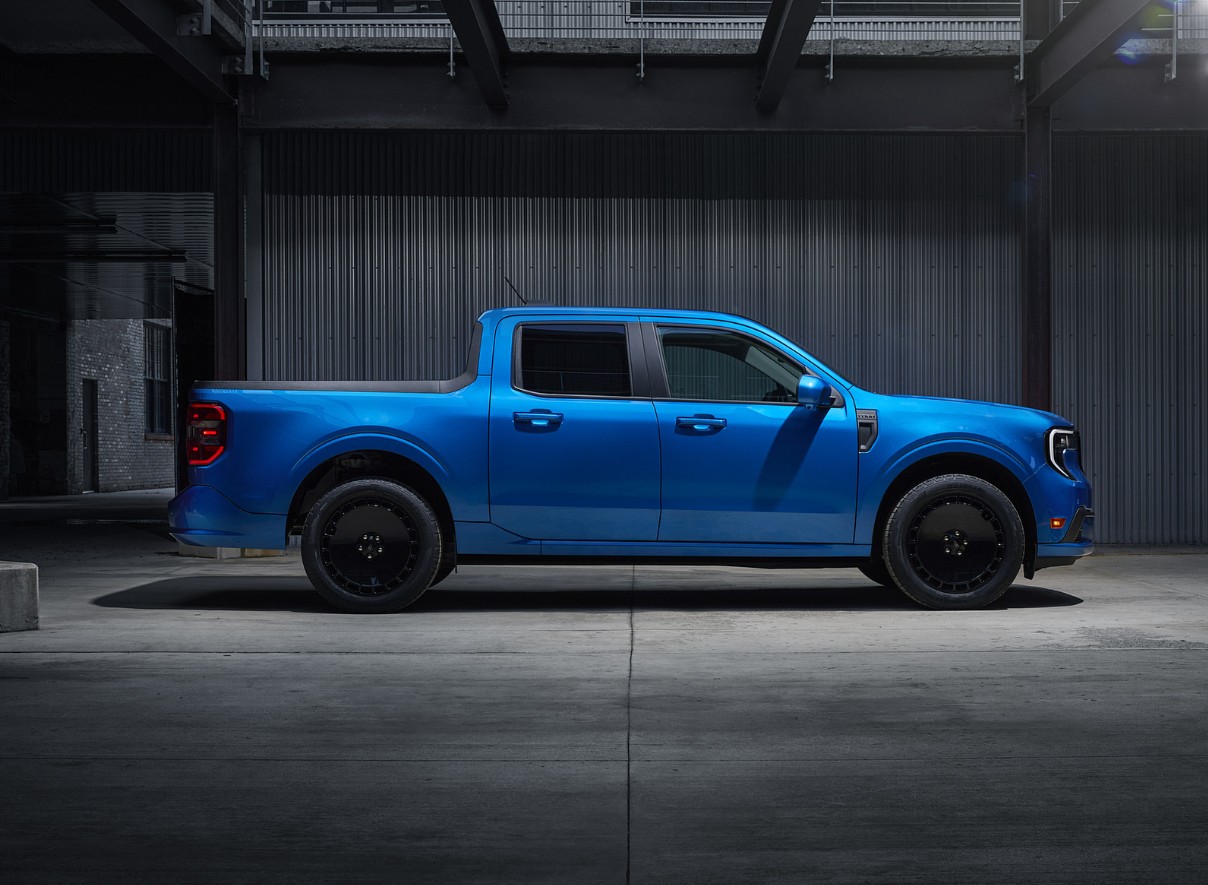
A potential 2028 update could therefore concentrate on refinement rather than changing the Lobo concept completely. Ford could introduce a sharper front fascia, revised aerodynamic details, lighter wheels, improved dampers, quicker steering calibration and stronger brakes while preserving the low-slung stance that separates the Lobo from the standard Maverick. The current Lobo is already lower than other Maverick versions, with Ford listing a 67.7-inch height compared with 68.8 inches for the standard Maverick and 69.4 inches for the Tremor. A future model could lower the visual profile further without sacrificing the pickup’s useful bed or everyday practicality.
The biggest opportunity would be giving the 2028 Lobo more sophisticated chassis software and thermal management. The current truck has a high-capacity radiator and cooling fan as part of its performance hardware, demonstrating that Ford designed it for more than appearance. A next-generation Lobo could add more advanced adaptive damping, revised torque distribution, improved launch control, stronger cooling and perhaps a more configurable performance display. Rather than chasing an extreme horsepower figure, Ford could focus on making the truck feel quicker, more precise and more consistent during repeated hard driving. That approach would preserve the Lobo’s unusual combination of compact dimensions, usable cargo capacity and sports-car-inspired behavior. 2028 Ford Maverick Lobo Redesign
2028 Ford Maverick Lobo Redesign and Update Plan
Exterior & Interior
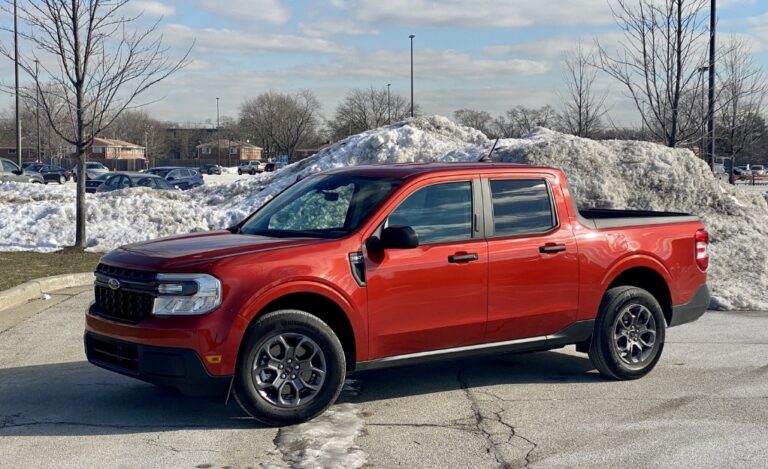
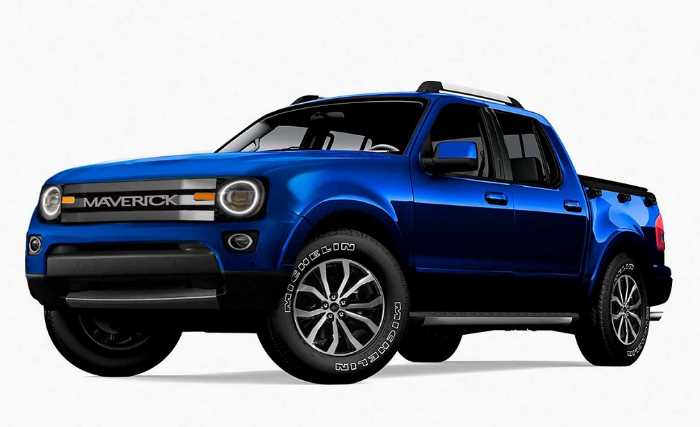
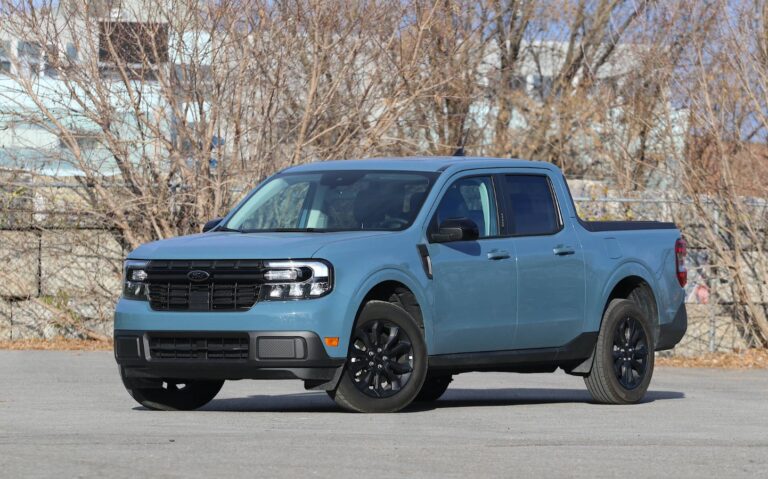
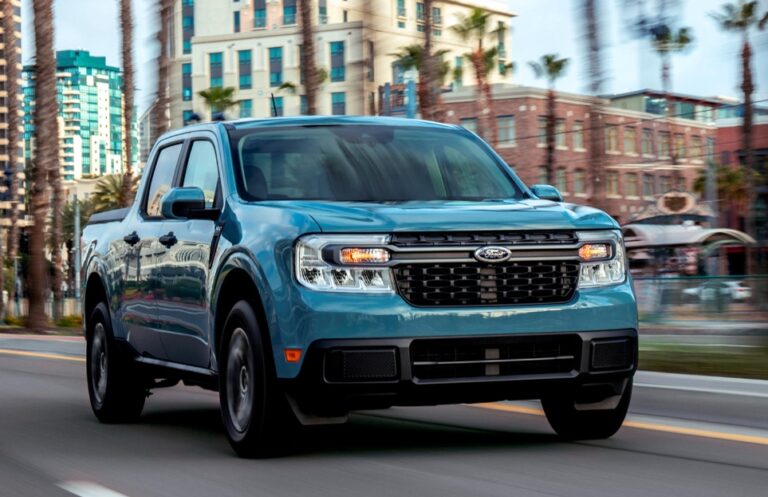
The exterior of the 2028 Ford Maverick Lobo should remain one of its strongest selling points. The current model immediately distinguishes itself through a black-painted grille, black roof, unique front fascia, body-color rocker panels and rear bumper, Lobo badging and 19-inch turbofan-style black-painted aluminum wheels. A future redesign could preserve these signature elements while making them more aerodynamic and purposeful. A lower front splitter, revised air curtains and more sculpted side skirts could give the truck a stronger road-hugging appearance while helping airflow around the compact body.
Wheel design could become an important part of the 2028 update. The current Lobo uses 19-inch turbofan-style wheels with 225/55 R19 tires, while Ford also offers 19-inch open-spoke black-painted aluminum wheels. A future performance package could introduce lighter forged wheels or a more aggressive staggered tire setup, although such changes would need to balance grip, ride quality and steering response. Lightweight wheels would be particularly valuable because reducing unsprung mass can improve suspension response without requiring major changes to the engine. A performance pickup does not need enormous wheels to look aggressive; carefully designed lightweight wheels could make the Lobo both faster and more comfortable.
The Maverick’s compact proportions should remain intact because they are central to its appeal. Ford lists the current Lobo at 200.9 inches long and 72.6 inches wide, with a 54.4-inch bed. The pickup provides a 33.3-cubic-foot cargo bed and a width of 53.3 inches across the bed overall. A 2028 redesign could slightly sharpen the body without dramatically increasing dimensions. Keeping the truck easy to park and maneuver would be especially important because its street-performance identity works best in urban environments. The Lobo should continue to feel like a compact pickup that can be driven aggressively on a winding road rather than a large truck pretending to be a sports car.
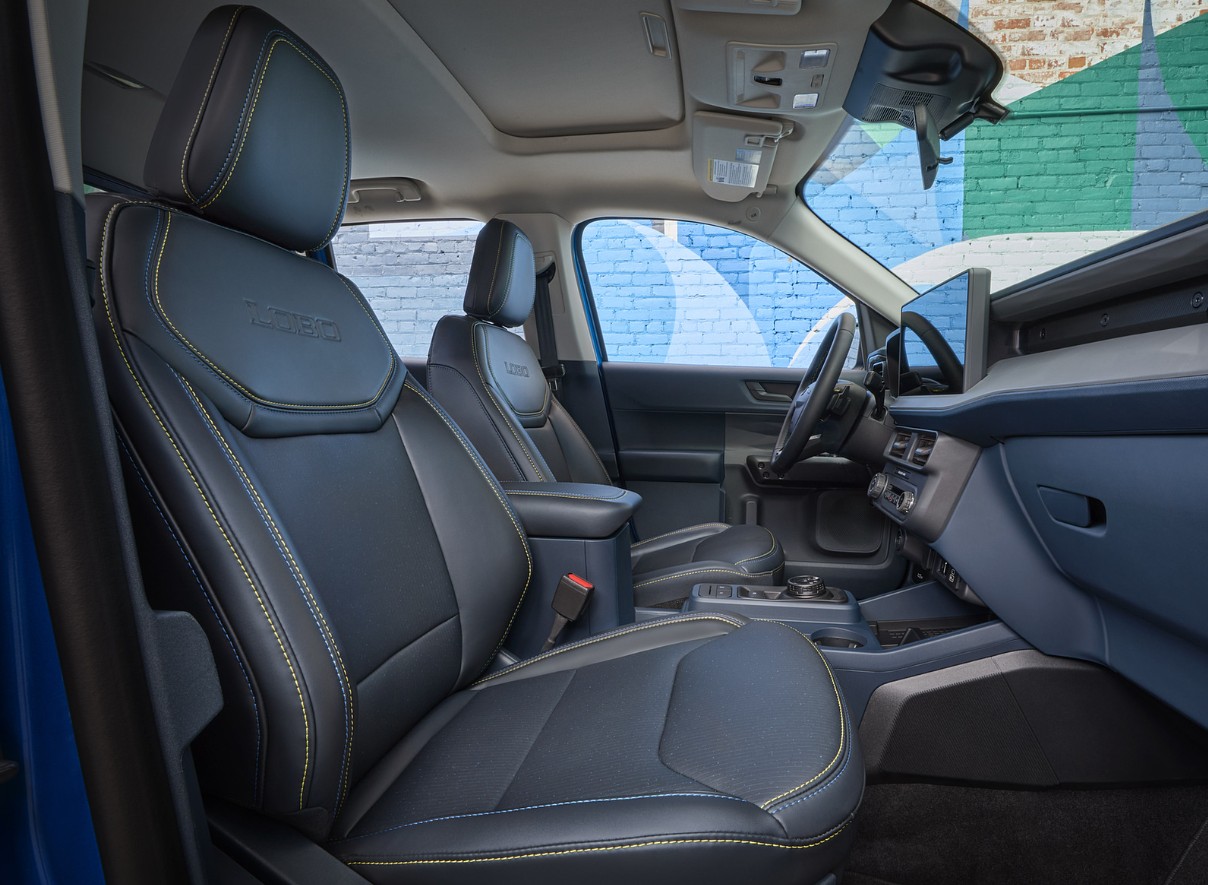
Inside, the 2028 Lobo could receive a more sophisticated interpretation of the current performance cabin. Ford currently equips the Lobo with black ActiveX-trimmed seating, Grabber Blue and Lime Green accent stitching, an eight-way power driver’s seat, an eight-inch cluster display and a 13.2-inch center touchscreen. A future model could expand the driver’s focus with larger configurable instrumentation, performance telemetry, tire-temperature information, G-force displays and more intuitive access to drive-mode settings. The cabin should remain practical enough for everyday use, with the folding rear seat and under-seat storage that make the Maverick more useful than a conventional sports coupe.
2028 Ford Maverick Lobo Specs
Engine & Performance
The current Maverick Lobo uses Ford’s 2.0-liter EcoBoost four-cylinder, producing 250 horsepower and using advanced 4WD with a seven-speed quick-shift transmission. Ford’s current specifications list the Lobo with a targeted 275 lb-ft of torque at 3,000 rpm, while its advanced 4WD system incorporates a twin-clutch rear drive unit capable of torque-vectoring behavior. For 2028, Ford could retain this engine but revise its calibration, cooling system and transmission software. An output increase toward 270–280 horsepower is plausible as a projection, but it is not a confirmed Ford specification. The stronger opportunity lies in improving throttle response and keeping the engine in its most effective operating range during aggressive driving.
The seven-speed quick-shift transmission is particularly important because the Lobo is not simply an appearance package. Paddle shifters and Lobo Mode allow the driver to influence the truck’s behavior more directly, while the special drive mode adjusts shift points, throttle response and handling characteristics. A future Lobo could make that system even more sophisticated by adding faster gear changes, stronger engine braking and a more customizable performance mode. A driver could potentially configure steering weight, shift aggressiveness, throttle sensitivity and torque distribution independently. Such software would give the compact truck a level of personalization more commonly associated with performance cars.
The chassis is where the Maverick Lobo has the potential to become genuinely special. Ford uses tuned springs and shocks, modified steering, enhanced brakes and a lower ride height, creating a truck that responds differently from the conventional Maverick. For 2028, adaptive dampers would be a particularly attractive upgrade. A system capable of switching between a compliant street setting and a firmer track setting could make the Lobo easier to live with every day while still giving enthusiasts more control on closed courses. Additional chassis bracing, improved bushings and revised alignment could further sharpen turn-in without making the truck unpleasant on rough pavement.
Towing would remain secondary to performance, but practical capability cannot disappear from a Maverick. The current Lobo has a maximum available towing rating of 2,000 pounds and a maximum available payload rating of 1,045 pounds. A future Lobo could maintain approximately those numbers while improving its performance credentials. The key would be preserving enough cooling and drivetrain durability for everyday truck use. Unlike a sports coupe, the Lobo has to carry equipment, transport passengers and occasionally tow a small trailer. That dual-purpose capability is one of the reasons the model can appeal to buyers who want performance without giving up the flexibility of a pickup. 2028 Ford Maverick Lobo Redesign
2028 Ford Maverick Lobo Fuel Economy
Fuel economy is one area where the Lobo necessarily gives up some of the Maverick family’s efficiency advantage. The standard 2026 Maverick Hybrid can achieve an EPA-estimated 42 mpg city in front-wheel-drive configuration, while the gasoline-powered Lobo is rated at 21 mpg city and 30 mpg highway. A future Lobo could improve those figures modestly through lower rolling resistance, better aerodynamics and optimized engine calibration, but a major increase would be difficult without changing the powertrain philosophy. Enthusiasts are buying the Lobo for its turbocharged performance, advanced 4WD and handling hardware, all of which naturally consume more energy than the economy-focused hybrid system.
The 2028 model could nevertheless become more efficient without becoming less exciting. Improved turbocharger response, reduced friction, more precise fuel injection, a smarter transmission and enhanced regenerative electrical accessories could reduce waste. Ford could also use a mild electrification system if packaging and cost allow, although there is no confirmation that such a system is planned for the Lobo. The priority should remain consistent performance. A Lobo that can deliver repeated acceleration and cornering without overheating its powertrain would be more valuable to enthusiasts than one that achieves a small improvement in highway MPG but loses its aggressive character.
2028 Ford Maverick Lobo Safety Features
The 2028 Lobo should continue using Ford’s Co-Pilot360 safety technology while adding more advanced driver assistance as the Maverick platform evolves. The current Lobo includes automatic high beams, lane-keeping technology, intersection assistance, pre-collision assist with automatic emergency braking, pedestrian detection, forward collision warning, dynamic brake support, post-collision braking, rear cross-traffic braking and a rearview camera. These systems give the truck a strong baseline, but a future version could add improved camera processing, better cyclist detection, more capable blind-spot monitoring and enhanced parking assistance.
The driving character of the Lobo makes calibration particularly important. A performance-oriented vehicle should provide safety systems that remain predictable when the driver is pushing the chassis, rather than producing unexpected interventions. Ford could separate everyday assistance from the more aggressive Lobo drive mode, allowing the driver to select a dedicated track configuration while keeping essential safety functions available. An optional 360-degree camera would also make sense because the Lobo’s sporty bodywork and low ride height can create visibility challenges around tight parking spaces. The current model already offers a 360-degree camera as an option.
2028 Ford Maverick Lobo Release Date & Price
Pricing for 2028 is not confirmed, so these figures should be viewed as projections rather than Ford MSRP. A price around $37,000 to $40,000 would allow the Lobo to remain an accessible alternative to larger performance trucks and sports-oriented SUVs. Higher specifications could push the truck beyond $45,000, particularly if Ford adds adaptive dampers, upgraded wheels, premium audio, advanced driver assistance and more powerful brakes. The current Lobo already occupies a unique pricing position because it provides factory-engineered performance at a cost far below many dedicated performance vehicles. Maintaining that value proposition would be essential to the nameplate’s future.
The release date is equally uncertain. Ford has not announced a 2028 Maverick Lobo or provided a confirmed redesign schedule. The current 2026 model remains relatively fresh, and Ford continues to expand the Maverick range rather than signaling an immediate replacement. For that reason, a late-2027 reveal followed by 2028 availability is one possible scenario, but it should not be presented as confirmed. Ford could instead carry the Lobo forward with smaller annual updates, introduce a more comprehensive Maverick refresh later, or change the performance formula entirely. Until official product information arrives, the 2028 model should remain classified as a projection.
The most compelling future Lobo would preserve the formula that made the current truck different: compact dimensions, a useful bed, turbocharged power, advanced 4WD, torque vectoring, lowered suspension and road-focused handling. The next step could bring more horsepower, faster software, adaptive dampers, lighter wheels, stronger brakes, better cooling and a more sophisticated cabin without transforming the truck into something fundamentally different. The current Lobo already demonstrates that Ford is willing to build a performance pickup around cornering ability rather than simply towing or off-road strength.
The 2028 Maverick Lobo is unlikely to use a traditional multi-trim hierarchy because the Lobo itself functions as a specialized performance series within the Maverick lineup. Ford’s current 2026 Maverick range includes XL, XLT, Lobo, Lariat and Tremor, with the Lobo positioned between the mainstream models and the more off-road-oriented Tremor in terms of personality. Ford’s current build-and-price site lists the 2026 Lobo at a starting MSRP of $35,930, although actual vehicle pricing can increase substantially with packages, destination charges and dealer-specific pricing. A 2028 version could retain the single Lobo identity while offering a selection of performance and appearance packages. 2028 Ford Maverick Lobo Redesign
Conclusion
The 2028 Ford Maverick Lobo remains unconfirmed, but the current Lobo gives Ford a compelling platform from which to build. Instead of following the traditional pickup formula, the Lobo takes a compact unibody truck and gives it the hardware normally associated with street-performance vehicles. The 2.0-liter EcoBoost, advanced 4WD, twin-clutch rear drive unit, seven-speed quick-shift transmission, performance-tuned suspension and exclusive Lobo Mode create a combination that is difficult to replicate elsewhere.
A future model does not need to become dramatically larger or more powerful to be successful. Better chassis control, faster transmission software, improved cooling, lighter wheels and more precise torque vectoring could make a 2028 Lobo substantially more capable while retaining its compact footprint. An output increase toward the high-200-horsepower range would be welcome, but the real gains should come from how efficiently the truck uses its existing power.
The practical side should remain equally important. The Maverick’s compact bed, five-seat cabin, storage solutions and towing capability give it advantages that a conventional sports car cannot match. The current Lobo already provides a 4.5-foot cargo bed and 2,000-pound maximum towing capability, so a future version can remain useful without abandoning its performance identity. That balance is what makes the Lobo more than an appearance package.
If Ford chooses to continue the nameplate into 2028, the ideal direction is clear: preserve the street-truck attitude while adding modern chassis technology, stronger performance, improved cabin quality and smarter software. With a projected price still well below most dedicated performance vehicles, the Maverick Lobo could remain one of the few pickups capable of delivering genuine driving excitement without sacrificing the everyday practicality that makes a compact truck so appealing. The 2028 model may not yet be official, but the formula Ford has created gives the Lobo plenty of room to become an even more distinctive performance pickup.